I recently prepared for an AI Technical Manager interview. The job description asked for someone who can think like a product leader, architect like a senior engineer and execute like a founder, plus deep MCP, agents, RAG and "vibe coding" experience.
So I wrote down every question I expected, and answered each one the way I would say it in the room. No buzzword soup, just how I actually build these systems. This page is the map. Every question has its own post with an architecture diagram.
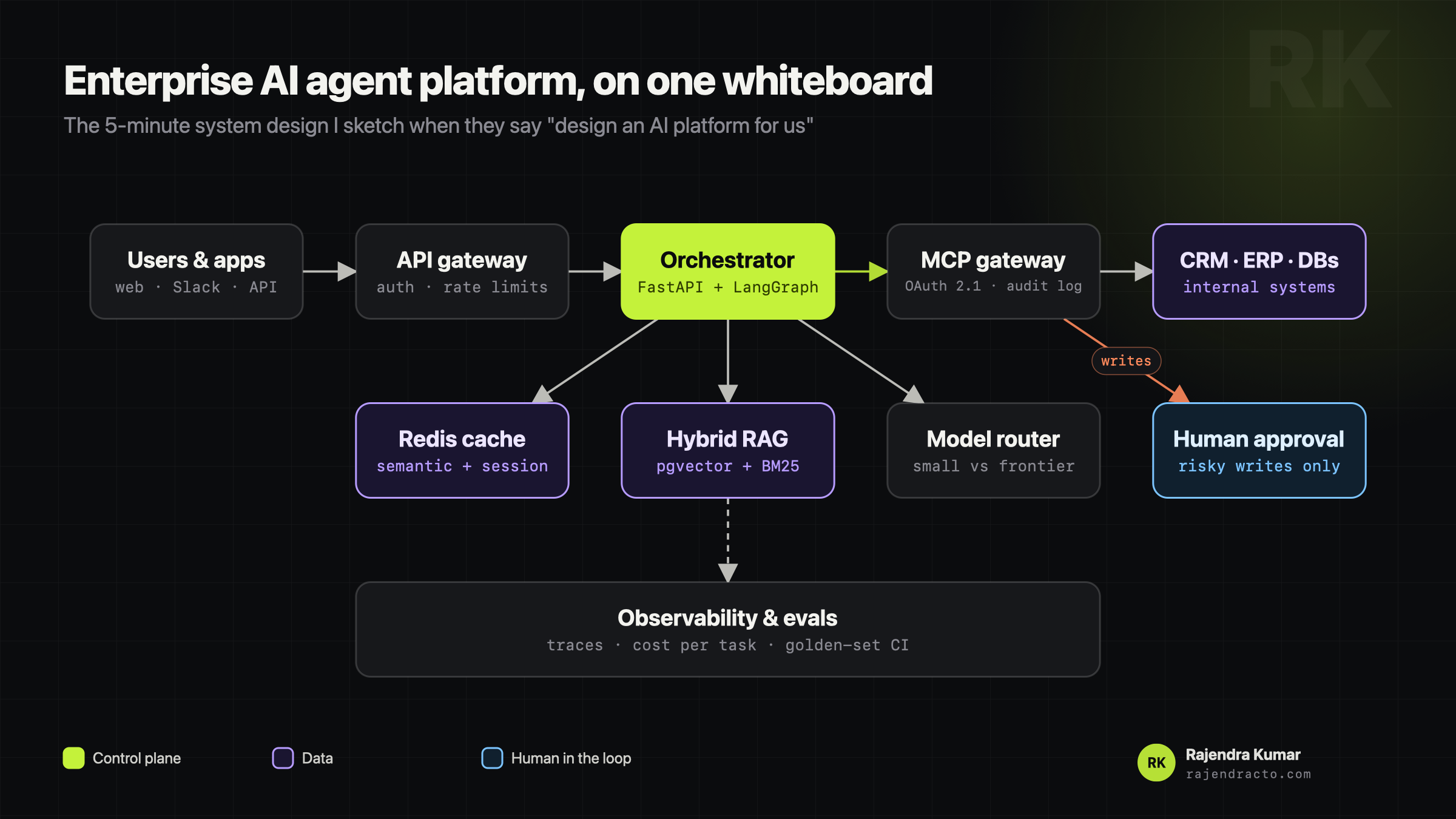
What this role is really testing
This is not a classic engineering manager job. It sits between a staff AI architect, an engineering manager and a product person. Expect them to jump from "how does OAuth work in MCP" to "how do you hire" in the same hour.
The good news: they want stories from production. If you have shipped AI features, you already have the answers. You just need to say them simply.
The basics they may check first
- What is an AI hallucination? Why models confidently make things up, and how grounding stops it.
- What is an event loop? Why FastAPI and Node can serve hundreds of LLM streams on one thread, and the one mistake that freezes everything.
MCP and enterprise integration
Agents, RAG and evaluation
Vibe coding, architecture and cost
Leadership and product thinking
How I structure every answer
When a technical question lands, I answer in three short beats. It keeps me from rambling and shows I think past the code.
- The principle. Why this approach, and what the trade-off is.
- The implementation. The actual stack: FastAPI, TypeScript, LangGraph, MCP with OAuth 2.1, pgvector, Redis.
- The outcome. What it did for latency, cost, security or team speed.
Questions I ask them back
- What is the biggest bottleneck in your delivery right now that you hope AI-native workflows fix in the next 90 days?
- Where are you between fixed workflows and autonomous agents in production, and what has been the hardest reliability or evaluation problem?
- How will you judge this role at six months: team velocity, new AI product features, or internal MCP and AI platform work?
Key takeaways
- 01Practise one whiteboard design until you can draw it in five minutes.
- 02Map three or four real projects to the job description before the interview.
- 03Principle, implementation, outcome. Every answer.